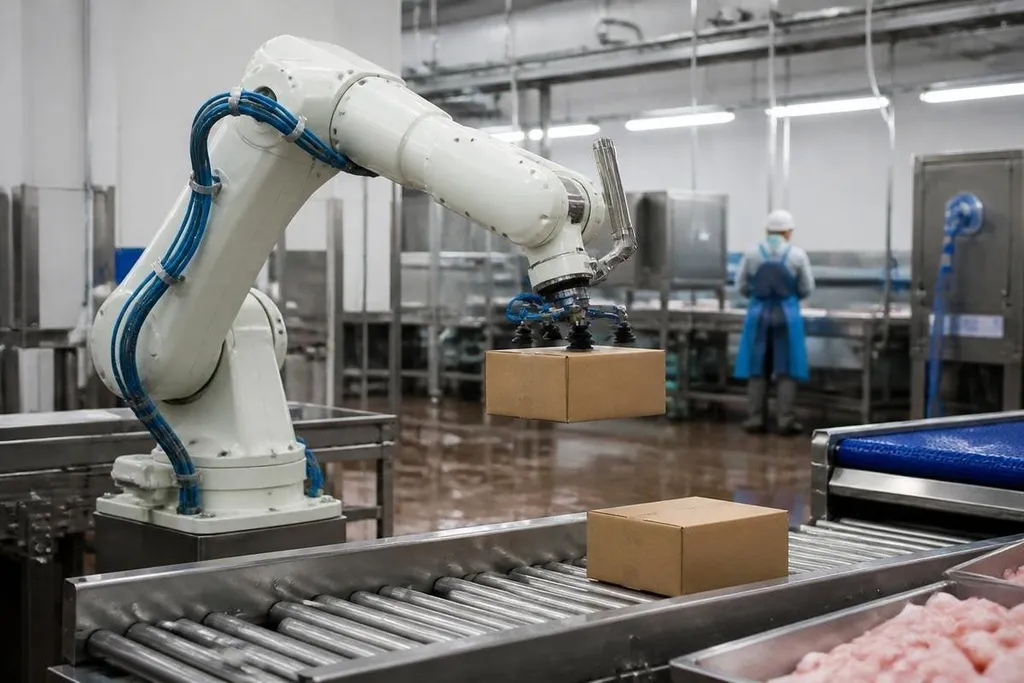
A food robot can pick a box in a test cell and still fail on a wet production line. Future food robots will need to handle soft products, washdown, food safety checks, and fast product changes without constant human correction.
- Grippers must handle food without crushing or tearing it.
- Washdown design matters as much as arm speed.
- Buyers should ask what happens when products change shape.
The hard part is handling food
Factory parts often have a known shape and a firm surface. Food changes from piece to piece.
A tomato may be soft, a pastry may crack, and a cut of meat may move when the gripper touches it. That puts pressure on the robot's end effector, the tool at the end of its arm.
A vacuum cup may work on a smooth package but fail on a wet surface. Fingers may hold a product more securely, yet leave marks or damage its surface.
Machine vision can help the robot find each item, but an image does not tell the whole story. The system also needs force sensing or another way to detect contact, so it can stop squeezing when the product starts to deform.
More progress in food automation will come from the full handling system, not from the arm alone. The camera, software, gripper, conveyor, and safety controls must work as one production cell.
Washdown changes the design
Food lines need regular cleaning. Water, foam, heat, and cleaning chemicals can reach motors, seals, cables, and sensors. A robot made for a dry assembly area may not survive that routine.
Buyers should check the robot's IP rating, which states how well its enclosure blocks dust and water. They should also check the shape of the arm. Flat surfaces and sealed joints leave fewer places for food residue to collect.
Cable routing matters too. A cable that hangs below the arm can catch product or trap dirt. A washdown-ready design needs protected cables, sealed joints, and parts that technicians can remove without taking apart half the cell.
A food robot can pick well and still lose time if its gripper needs a long wash and reset. Reports from Robot24 can put the changeover time, washdown method, and test site beside the maker’s claim.
Changeovers decide the payback
A food plant may run one product in the morning and another later in the day. Each change can require a new gripper, a new camera setting, a new robot path, or a fresh safety check.
A system that needs a specialist for every change may save labor at one station while adding delays elsewhere. The better design lets a trained operator load a recipe, check the work area, and confirm the first pieces without editing robot code.
That does not mean every change can be automatic. Product size, moisture, packaging, and surface texture can shift the result. The supplier should show the robot handling the actual products, not similar objects from a clean demonstration table.
Safety and food quality share the cell
This robot needs the same safety controls as other industrial automation, along with rules for product contact. The cell must stop when a person enters the protected area, and the gripper must be easy to clean or replace.
The design should also separate food-contact parts from parts that hold grease, dust, or electrical hardware. That makes inspection easier and reduces the chance that a small machine fault reaches the product.
The open question is fault recovery. If the robot drops a product, sees two items together, or loses its camera view, the system should stop in a known state and tell the operator what to check. A restart button alone is not a recovery plan.
A buyer's check before signing
Use this list during a supplier test. Ask for video or a live run with your own products.
- Product range: Test the smallest, largest, softest, and most misshapen items.
- Gripper cleaning: Remove food-contact parts and record the cleaning time.
- Washdown proof: Check the stated IP rating and the cleaning method it covers.
- Changeover work: Time a recipe change with the staff who will run the line.
- Fault recovery: Make the system face a dropped item, a blocked view, and an empty pick.
- Data trail: Confirm that rejects, stops, and operator actions are recorded.
I'd skip a food robot that only works when every item arrives in the same shape. The better purchase is the cell that handles real product variation, survives its cleaning routine, and gives operators a clear recovery step when the process breaks.
That standard leaves one practical test: run the robot through a full shift of production and cleaning before you count its savings.